
Proper golf simulator acoustic dampening stops loud echoes inside the room. Meanwhile, structural soundproofing stops low-frequency thuds from traveling through your walls. You must use both strategies to protect your hearing and avoid bothering nearby people.
The difference between treating and blocking sound
People often buy lightweight foam panels expecting them to block all simulator noise. However, foam only treats airborne echo inside the space.
When a homeowner lines a bonus room with thin foam, their family still hears loud floor thuds. The homeowner quickly realizes foam only fixes internal room echo. They must add a thick rubber mat to absorb vibrations traveling through the floor joists.
Why loud clubs risk your hearing indoors
The noise inside a simulator poses a genuine health risk to your ears. According to independent research published by PubMed, a titanium driver swing generates a high-frequency impact noise peaking at 119.9 decibels. This means you are creating sound levels similar to a siren right next to your own ears. In a small garage or basement, those sharp sounds bounce back at you instantly.
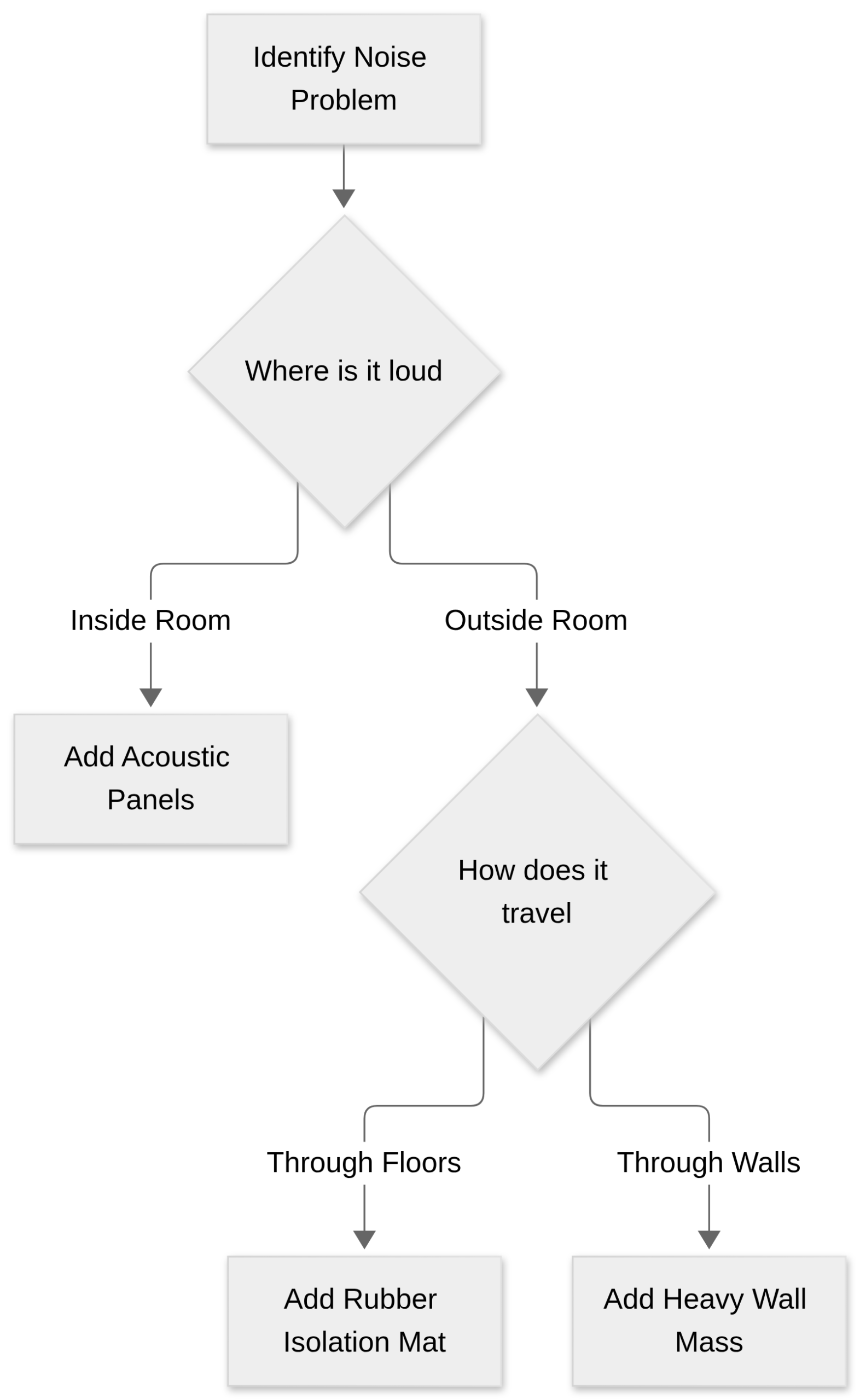
The Occupational Safety and Health Administration warns that prolonged exposure to noise above 85 decibels causes permanent hearing damage. This shows why relying solely on earplugs is not enough for avid indoor golfers. You must actively soften the room to bring overall noise levels down to a safe range. This flowchart maps out the right solution for your specific noise problem.
Treating airborne noise with acoustic panels
You must absorb high frequencies bouncing off hard walls to fix in-room echoes. Thick foam panels or padded wall baffles trap these sound waves before they reflect. Place your panels directly beside and behind the hitting area.
A heavy impact screen also absorbs much of the ball flight noise upon contact. Hanging extra curtains or baffles near the screen catches stray frequencies. This dampening process lowers the immediate volume for the golfer and makes the space comfortable for daily practice.
Stopping floor vibrations with rubber mats
The sharp crack of the club is only half the problem. The heavy thud of your club hitting the mat travels straight down through the floor joists. Decoupling your hitting surface from the hard floor solves this problem.
You can reduce structure-borne impact noise by 6 to 10 decibels using a thick rubber pad. This data comes from Second Skin Audio, a company that sells soundproofing materials. This means you prevent the heavy club thud from traveling down and shaking the rooms below.
Upgrading walls with heavy mass
If you want to stop sound from escaping the room, you need to add heavy mass. Standard drywall allows low-frequency energy to pass through easily. This causes the loud golf impact to leak into adjacent offices or bedrooms.
Adding a second layer of drywall with sound-damping glue improves wall isolation by 12 to 15 decibels. This fact comes from All Seasons Design Build, a company that sells soundproofing materials. Adding dense mass to your walls is the best way to prevent loud drives from echoing through the house.
The best next step is to hit a few balls while a partner stands in adjacent rooms. They can tell you exactly where the noise is traveling so you buy the right materials. If you need help setting up a quiet space, contact the team at GimmeGolfSim today.