
Designing a premium golf simulator in a multi-use space like a high-end garage or luxury media room requires a system that performs flawlessly during play but completely disappears afterward. Achieving this invisible footprint goes far beyond buying a standard motorized roller. Engineering a genuinely concealed retractable golf simulator screen involves calculating roller tube deflection over wide spans, framing precise architectural soffits to hide the motor, and designing a bottom-tensioning system that maintains a perfectly flat projection surface.
Many out-of-the-box solutions treat retractability as a simple accessory, ignoring the structural reality of hanging heavy impact materials. A successful concealed installation demands careful integration into the room’s architecture. By planning the exact dimensions of the ceiling cavity and addressing the physics of the roller mechanism, you can create a high-tension hitting experience that reverts to a clean, open living space when the round is over.
The following flowchart outlines the primary decision path for selecting and mounting a retractable impact screen based on your room dimensions.
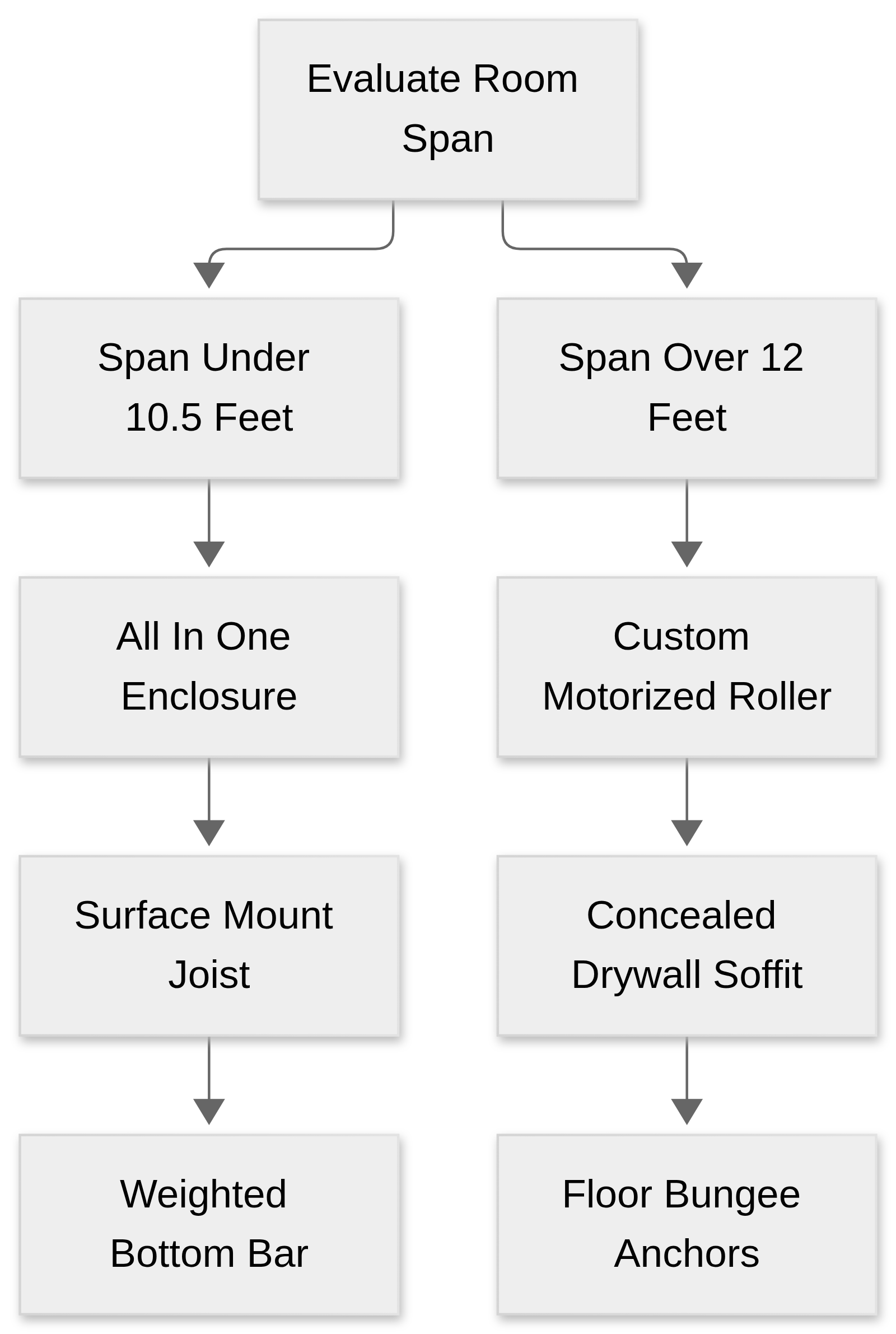
Calculating Roller Deflection for Wide Span Screens
The physical weight of heavy-duty golf impact screen material introduces immediate structural challenges for motorized rollers. According to Carl’s Place premium impact screen specifications, standard heavy-duty materials weigh approximately 14 to 16 ounces per square yard. A standard 10×12 foot screen adds 14 to 16 pounds of dead weight to the roller, and that figure entirely excludes the weight of the bottom tension bar.
As the width of the screen increases, so does the risk of tube deflection, which is the tendency for a roller to sag in the middle under heavy loads. The SportScreen golf studio integration guidelines note that motorized aluminum roller tubes spanning 12 feet or more require a minimum diameter of 3 to 4 inches. Failing to specify the correct tube diameter and material for wide spans results in permanent V-shaped wrinkles stretching across the impact material. Systems like The SportScreen are available in standard widths of 10, 12, 14, and 16 feet, utilizing rigid rollers that mount directly to ceiling joists and run on standard 110V power to handle these structural loads without sagging.
Architectural Concealment: Sizing Soffits and Ceiling Joists
Hiding the roller mechanism requires precise framing during the initial build or renovation phase. A standard surface mount leaves the motorized tube visible, which disrupts the aesthetic of a premium living space. To completely conceal the rolled screen and its mechanics from view, the system must be housed inside a finished drywall soffit.
Premium custom integrations, such as the Par2Pro Stealth Retractable System, utilize heavy-duty Somfy tubular motors that demand specific vertical clearance. Based on the Par2Pro Stealth system documentation, the custom ceiling soffit must have a depth of at least 14 inches. This dimension ensures the bulky roll of heavy-duty screen material, along with the motor housing and mounting brackets, fits entirely flush within the ceiling architecture. The framing surrounding this soffit must also be heavily reinforced to support both the static weight of the assembly and the dynamic pulling force generated by high-velocity golf ball impacts.
Engineering the Bottom Edge: Weights vs. Floor Anchors
Managing the bottom edge of the impact screen is the most demanding logistical aspect of a retractable system. To achieve safe ball rebound and a perfectly flat surface for projection, the screen must remain under constant vertical tension. According to the Gungho Golf retractable setup guide, this requires either a weighted fiberglass and metal bar enclosed in the bottom hem or a floor bungee anchor system.
While a weighted bar allows the screen to drop and be ready for play immediately, it often provides less tension than physical anchors. Floor bungees offer superior rigidity, pulling the screen taut to eliminate rippling, but they introduce a manual step into the room’s transition. The user must manually unclip and manage the bottom tension bar or floor bungees before engaging the retraction motor. Retracting the screen while anchors are still attached will severely damage the tubular motor or tear the impact material.
Positioning Launch Monitors and Projectors for Dual-Use Rooms
In a multi-use room, overhead technology must coexist with the retractable screen without creating visual clutter or obstructing the retraction path. A luxury residential media room might feature a custom 16-foot wide heavy-duty impact screen mounted on a 4-inch aluminum roller tube housed inside a finished drywall soffit. When the golfer unhooks the floor bungees and retracts the screen completely out of sight, a traditional 4K acoustically transparent home theater screen can descend in its place. The ceiling-mounted launch monitor (e.g., Uneekor EYE XO) remains permanently fixed, doubling aesthetically as a smart-home fixture.
Smaller setups require similar spatial awareness. For example, a homeowner transforming a standard two-car garage with a HomeCourse Pro 180 can mount the wireless, battery-powered roller directly to 9-foot ceiling joists. The HomeCourse specifications indicate this screen spans 10 feet 6 inches at the bottom and requires a minimum ceiling height of 8 feet 6 inches. After a session, a click of the remote retracts the impact screen and side netting enclosures simultaneously in roughly 30 seconds, restoring the space for vehicle parking. In all applications, launch monitors and short-throw projectors must be installed at calculated distances to avoid physical interference with the screen’s vertical travel path.
Contact the design team at GimmeGolfSim to engineer a custom retractable simulator solution tailored to your exact floor plan.